“Innovate today. Nourish tomorrow.” was the theme of the 2026 World Food Forum (WFF), convened by FAO in Rome last week. The theme reflects basic agricultural knowledge: what you plant today is what you harvest tomorrow. For food systems transformation, however, the harvest will depend on how these ambitions take root.
Alongside its emphasis on innovation and investment, the WFF’s framing also recognises the importance of traditional knowledge, food sovereignty and meaningful youth engagement to ensure that everyone can access nutritious food while safeguarding the planet for future generations. But what does inclusion mean when investment priorities are set? How does recognition of traditional knowledge inform the solutions receiving support? And what does meaningful youth engagement look like when programmes are designed and budgets allocated?
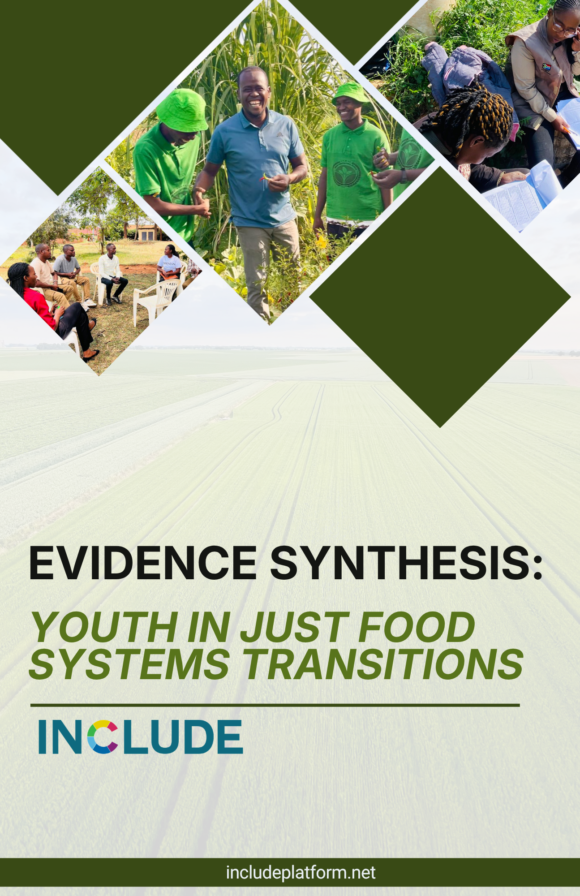
These questions go to the heart of a just food systems transition. They also motivated INCLUDE’s recently completed Youth in Just Food Systems Transitions research programme. Across five African countries, the research examined how decisions about resources, knowledge and risk shape young people’s livelihoods—and whether young people can influence those decisions. Producing more food, adopting cleaner technologies and attracting investment can all contribute to change. Whether that change improves people’s lives also depends on who controls productive resources, whose knowledge informs decisions, how risks are shared and where the value created ultimately ends up.
Across Africa, where young people are expected to drive food systems transformation, how far have these ambitions translated into practice?
African governments are translating national food systems pathways into programmes and investment plans while aligning them with the African Union’s CAADP–Kampala framework. The Strategy for 2026–2035 aims to increase agrifood output by 45%, mobilise US$100 billion in investment and triple intra-African agricultural trade. These are targets, rather than achievements. They establish the scale of the ambition. How opportunities, costs and benefits will be distributed requires closer scrutiny.
At the UN Food Systems Coordination Hub’s Fourth Africa Regional Food Systems Transformation Meeting in Accra in May 2026, countries reported progress in turning national pathways into action. According to its report, 50 African countries had appointed National Food Systems Convenors which situate food security and nutrition within national and regional food sovereignty objectives. The Gambia described platforms bringing youth associations, farmer cooperatives and women’s groups into intervention design, while Cameroon initiated peer exchange with six countries on governance, resilience and stakeholder engagement. Participants also called for more coherent monitoring frameworks, including at subnational level, to capture differences in local outcomes. Ghana, for example, presented its national food systems dashboard, aligned with CAADP reporting to track progress in food systems transformation.
Financing and accountability mechanisms are also developing. The report recorded that seven African countries had received catalytic support through the Joint SDG Fund’s food systems financing window for implementing national pathways. Public investment is also delivering tangible benefits. In Benin, local purchasing for school meals contributed more than US$23 million to the economy in 2024, connecting better nutrition with markets for local producers. Congo, Mali and the Democratic Republic of Congo shared experiences with innovative approaches like dedicating portions of mineral wealth income to food security and sustainable agriculture projects. Other countries, like Gabon and Rwanda, make use of specialized funding mechanisms. Yet the Accra meeting assessed overall progress as solid but insufficient, with affordable finance particularly difficult to access for women and young people.
For young people, progress also means being able to access land, earn a decent income, negotiate fair terms and influence decisions affecting their futures. A seat at a consultation does not tell us how much influence someone has when the budget is decided.
This is where the emphasis of many government- and donor-led programmes on training, entrepreneurship and innovation needs a closer look. What can a newly trained young farmer do without secure access to land? What does a digital market platform offer someone without reliable transport, storage or bargaining power? And who can afford to experiment with greener practices when they must absorb the costs and risks themselves? The questions motivated our recent research programme.
Addressing the gap between ambition and reality: what the country evidence reveals
Our country case studies examined these conditions in practice. Across Benin, Ghana, Rwanda, Somalia and South Africa, they examined how opportunities for young people are shaped by access to resources, institutions and the distribution of power. The programme’s evidence synthesis finds that skills, technologies and entrepreneurship support are unlikely to deliver equitable outcomes without addressing the structural barriers embedded within food systems. The issue is therefore whether young people can build viable livelihoods and gain greater influence over the food systems in which they already work.
Across the five case studies, the gap between ambition and lived experience takes different forms, each offering a practical test of what a just food systems transition would require:
In Benin, the study shows why promoting green opportunities is not enough to make them accessible. Among the young people surveyed, land ownership and specialised training were associated with greater participation in green agricultural activities, while young women remained less likely to participate, even after accounting for other measured characteristics. Awareness of green jobs, meanwhile, was not significantly associated with participation. The findings suggest that, although youth are highly interested in green jobs, encouraging young people to embrace sustainable agriculture must go hand in hand with addressing the unequal conditions under which they enter it.
- How can support for greener livelihoods reach young people who lack land and resources, particularly young women?
In Ghana, the Tamanaa rice-processing case illustrates both the gains and the limits of inclusion through agribusiness. Women participating in its value chain described more reliable markets, improved incomes and greater influence within their households. Yet participants also raised concerns about low pay and inadequate protection from the intense heat of parboiling, while unequal land access persisted. Their increased economic contribution did not extend to involvement in decisions about the design or operation of the value chain.
- How can investment in food value chains deliver decent work and greater bargaining power alongside expanded participation?
In Rwanda, strong government leadership has supported agricultural transformation, but the study identifies a gap between consultation and influence. Participants reported that their views were considered mainly when they fitted predefined national strategies, while formal youth representation did not adequately reach less-connected smallholders and informal enterprises. The transition also carries practical risks: farmers with little land and narrow financial margins described being unable to risk income losses while experimenting with more sustainable practices.
- What would it take for young farmers to receive the support needed to bear the costs and risks to practice sustainable farming?
In Somalia, the researchers show how employment barriers are intertwined with conflict, displacement and social exclusion. Training programmes have weak links to employment, while access to opportunities is shaped by location, clan connections and resources. Community organisations with the relationships needed to reach marginalised young farmers often have the least funding, and farmers have little influence over programme priorities. The authors argue that market-oriented interventions need to address insecure tenure, discrimination and the lasting harms of conflict.
- How can food systems investment support viable livelihoods for young people whose exclusion is rooted in displacement and historical injustice?
In South Africa, comparative research in the Eastern Cape and Gauteng exposes the distance between acquiring capabilities and being able to use them. Young participants described gaining skills and information while remaining constrained by access to land, finance and markets. They also reported opaque support programmes and entry requirements set by agribusinesses that disadvantaged small-scale and youth-led enterprises. The study’s analysis of perceived green opportunities therefore raises a question about the institutions governing access, beyond the readiness of young people themselves.
- What changes to market rules, procurement and resource allocation would enable young people to turn their capabilities into secure livelihoods?
The road ahead: young people need the power to shape the transition
Meaningful involvement of young people cuts across all the findings presented above—this needs to be done intentionally. Speaking to Climate Lens News while representing INCLUDE at the Africa Food Systems Forum 2026, Brian Kithinji put it plainly: “We need to recognise young people as equal players”. That means influence over policies and budgets, alongside practical action on the barriers that prevent young people from building viable livelihoods.
His guide, Designing Meaningful Youth Engagement in Food Systems Research, developed through our programme, starts with how knowledge is produced:
- involve diverse young people early,
- give them clear decision-making roles,
- resource their participation,
- demonstrate how their contributions shape the findings.
Applied seriously, these principles can help ensure that the evidence informing transformation reflects the people expected to drive it.
Brian also encourages young people to keep developing their skills, join policy conversations and explore cooperatives as a route to accessing finance and working together. These efforts need institutions willing to share power and resources. Staying motivated should not mean being left to overcome structural barriers alone.
To young people already working towards fairer and more sustainable food systems: stay ambitious, build alliances and keep bringing your experience into the decisions that matter. You deserve opportunities to put your ideas into practice and a fair share of the value you create. As Brian says: “Do not give up.”
For more on our research findings and meaningful youth engagement, watch Brian’s interview at Kenyan Y-morning show.
Image credit: FAO Science and Innovation Forum 2026