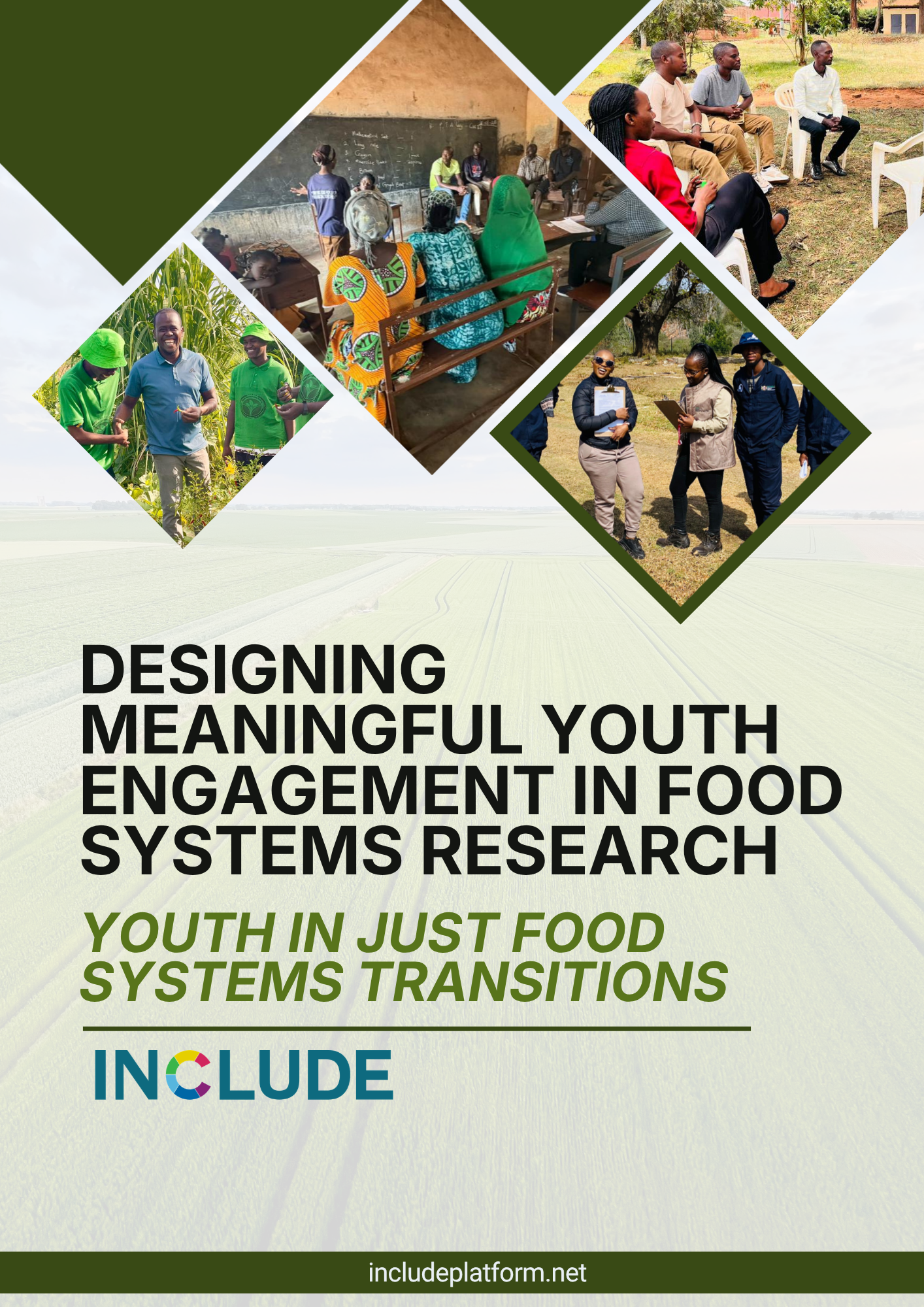
Meaningful youth engagement has become an increasingly prominent requirement in research, policy, and development programmes. Yet in many studies, youth participation remains largely procedural, serving as a donor compliance requirement rather than a methodological approach that strengthens research quality. This paper advises that meaningful youth engagement should be understood not simply as participation, but as a deliberate research practice capable of improving the relevance, credibility and analytical depth of food systems research.
Drawing on comparative evidence from five INCLUDE-commissioned case studies in Benin, Ghana, Rwanda, Somalia and South Africa, undertaken through the Youth in Just Food Systems Transitions research programme, the paper examines how meaningful youth engagement was operationalised across diverse political, institutional and socio-economic contexts. It analyses the conditions under which youth participation influences research design, implementation and interpretation, while proposing practical guidance for researchers and institutions seeking to embed meaningful youth engagement throughout the research cycle.
Specifically, the paper addresses three interrelated questions:
- How were youth engaged across different stages of the research process?
- How were youth positioned within research processes and decision-making structures?
- How did youth participation influence problem framing, methodological choices and interpretation of empirical findings?