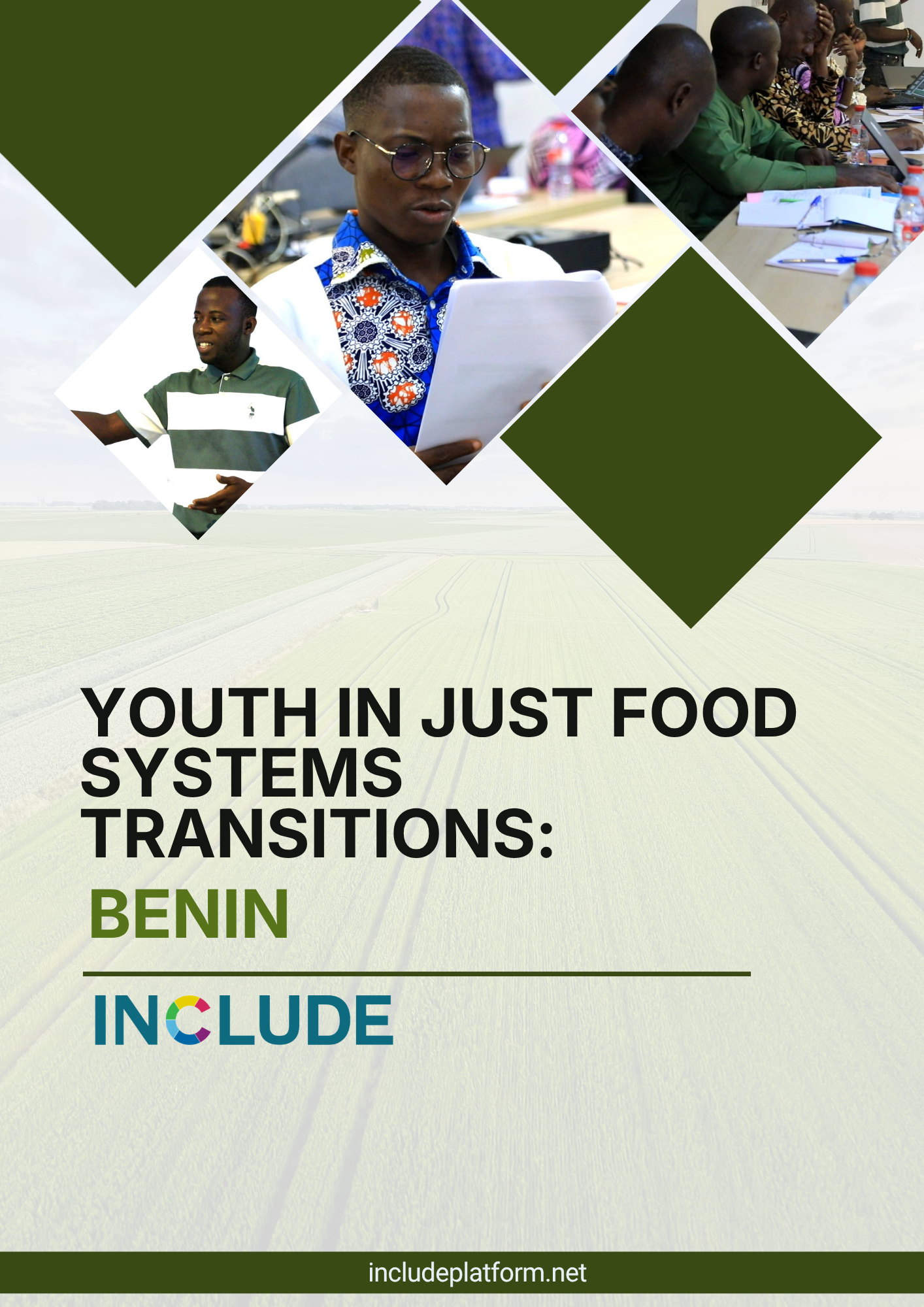
New case study from INCLUDE’s Research programme Youth in Just Food Systems Transition on food systems in Benin by Tranquillin Affossogbe working for the International Fertilizer Development Center (IFDC).
Across Africa, governments and development partners are investing heavily in green agriculture, digital innovations and youth entrepreneurship. But when access to land, finance and decision-making remains unequal, who is actually able to benefit from these opportunities?
Our latest case study from Benin shows that the challenge is not a lack of ambition among young people:
- >60% of youth had never heard of the concept of green jobs, yet >90% considered it a major opportunity once informed.
- 92% of surveyed youth aspire to establish their own agricultural business.
- Yet only 13% own agricultural land.
- Only 4% have received training in digital agricultural skills.
- Women remain systematically excluded from higher-value segments of food systems, driven by dual productive and reproductive burdens, mobility constraints, discriminatory access to productive assets, and entrenched social norms.
Evidence from three high-potential value chains for green employment – organic and agro-ecological vegetable production, sustainable agri-food processing, and digital marketing of agricultural products – shows:
Access to land remains the single most important determinant of participation in green jobs, while youth participation in policymaking often remains symbolic, and representation in cooperatives and producer organisations rarely translates into meaningful influence over resource allocation and decision-making.
Closing the gap requires simultaneous action targeting material conditions of agricultural work, the institutional status of youth innovation and the structural invisibility of young women’s contributions through policy mechanisms.
The researchers formulate evidence-based recommendations structured around four dimensions of justice.