Food systems across Africa are changing rapidly in response to climate pressures, technological shifts, and evolving markets. They are deeply vulnerable to climate change impacts and climate change poses severe threats to farmers across the continent. There is an urgent need to transition to food systems that are more resilient, equitable and environmentally sustainable. As many livelihoods depend on food systems, changes need to be made with great care to ensure the transition itself is fair and inclusive. In this context, the concept of a ‘just food systems transition’ is gaining traction in national strategies and international development as a way to address these multiplex challenges.
However, government policy provides little direction on what kind of outcomes a just transition in our food system should engender, or indeed what constitutes a transition that can be classified as ‘just’ by the breadth of constituencies affected, especially for vulnerable communities. Young people are at the heart of these changes, yet the employment outcomes of food systems transformations are far from automatically inclusive or fair. Consequently, there is a clear need for a holistic perspective that takes into account the implications specifically for youth and women, as they both bear the brunt of inequalities and climate change impacts and are the ones driving the food systems transformation. One that provides just transition pathways to build resilience in food systems in socially just ways and create much needed employment opportunities in the form of green jobs for Africa’s youth.
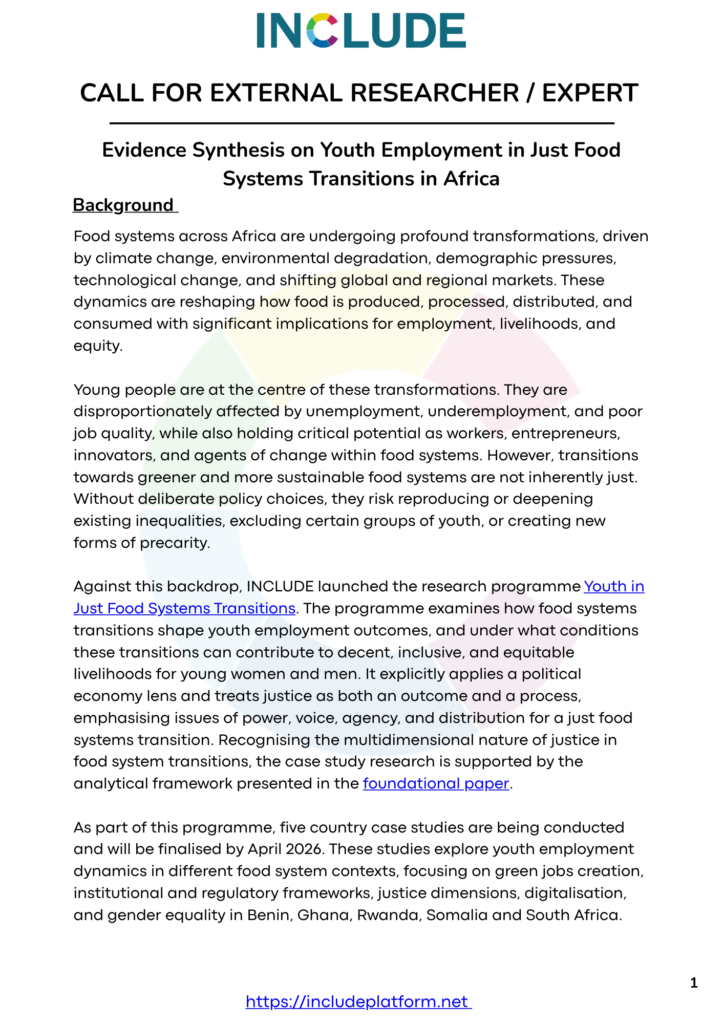
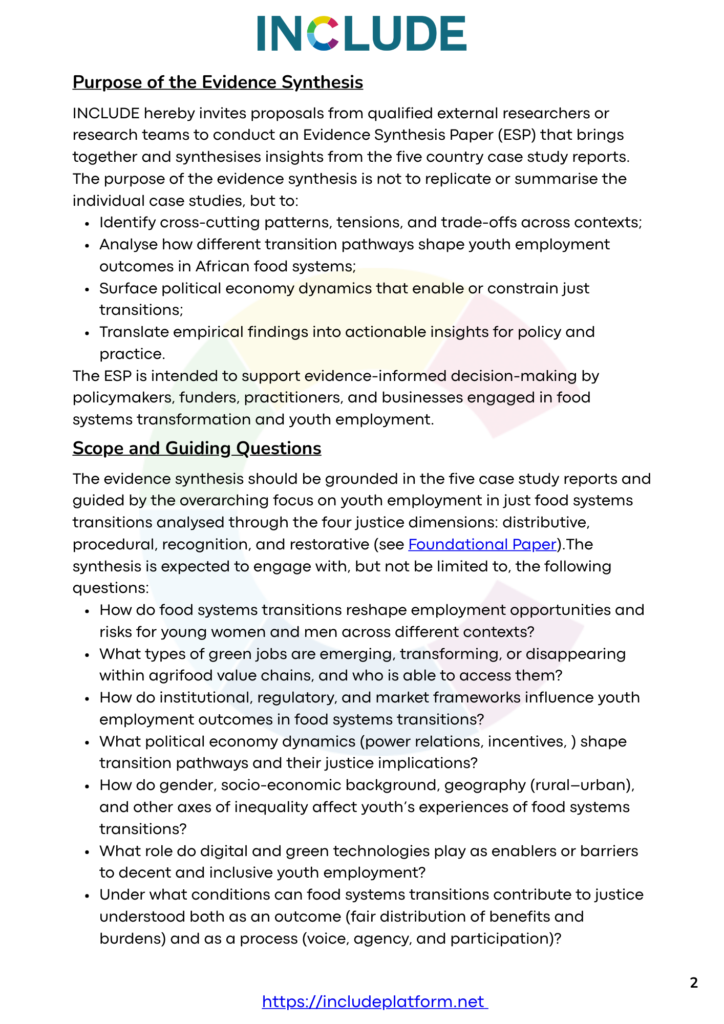
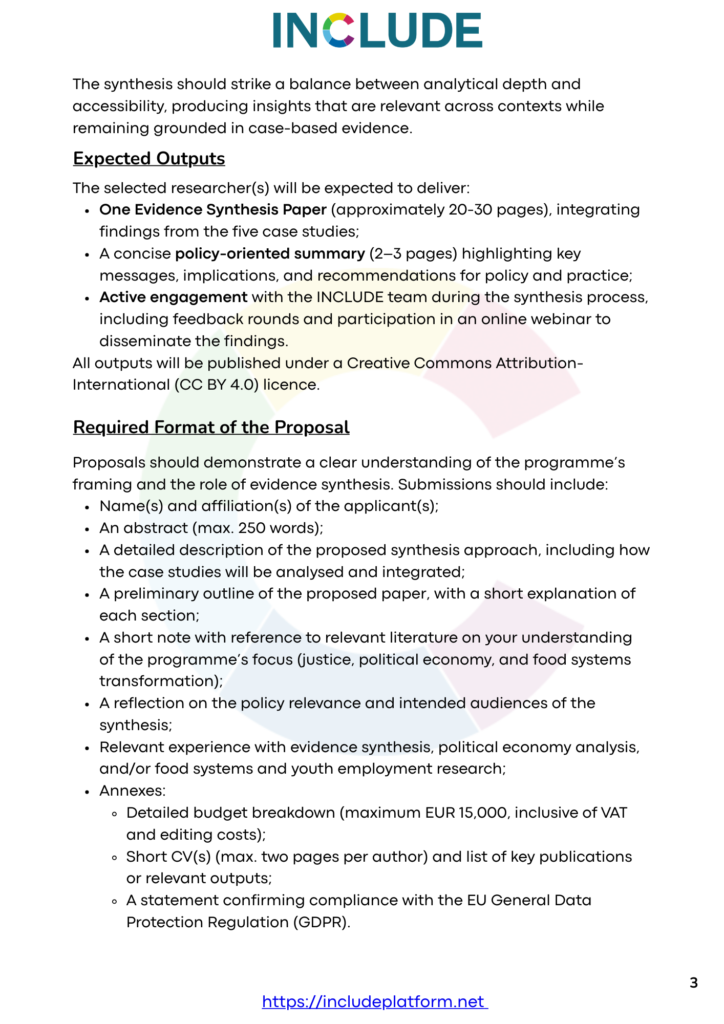
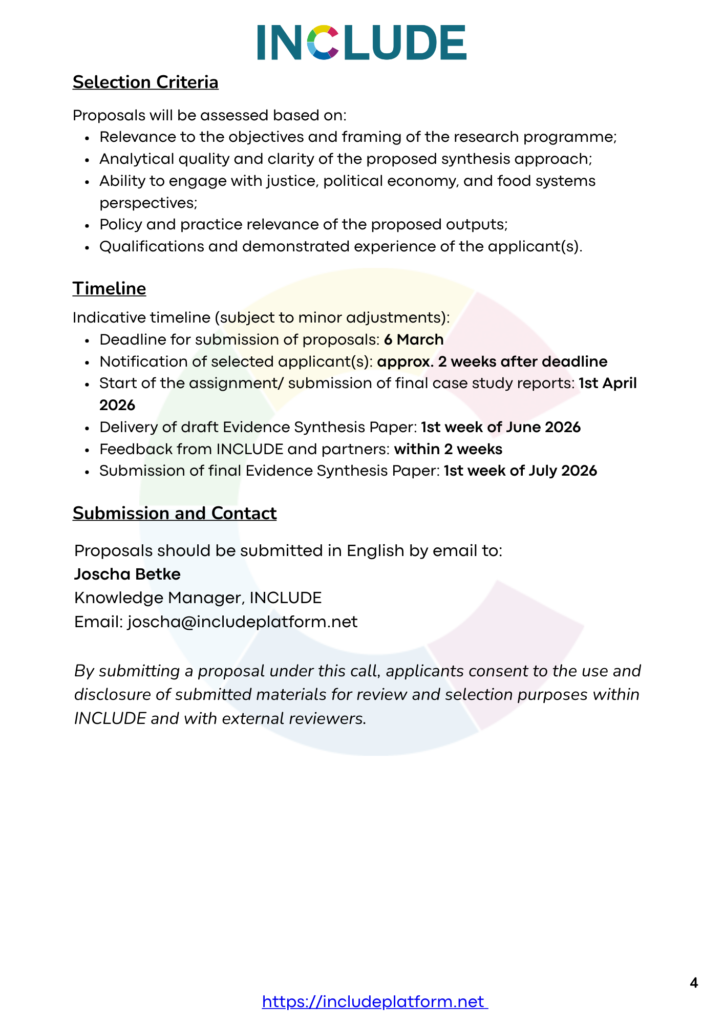
As part of its research programme Youth in Just Food Systems Transitions, INCLUDE invites external researchers or research teams to develop an Evidence Synthesis Paper (ESP) that brings together insights from the five country case studies that are currently being conducted in Benin, Ghana, Rwanda, Somalia, and South Africa. The synthesis will focus on how different food systems transformation pathways affect youth, and under what conditions these transitions can contribute to decent, inclusive, and just livelihoods for young women and men.
Rather than summarising individual cases, the evidence synthesis is expected to identify cross-cutting patterns, tensions, and trade-offs across contexts, with explicit attention to political economy dynamics and multiple dimensions of justice. The aim is to generate analytically robust and policy-relevant insights that can inform decision-making by policymakers, practitioners, funders, and businesses to advance strategies to implement just food systems transitions.
The selected researcher(s) will produce a full Evidence Synthesis Paper, a concise policy-oriented summary, and engage with INCLUDE in disseminating the findings. All outputs will be published open access.
Please download the Call for Evidence Synthesis for details on scope, requirements, selection criteria, and submission guidelines.
Deadline for proposals: 6 March 2026